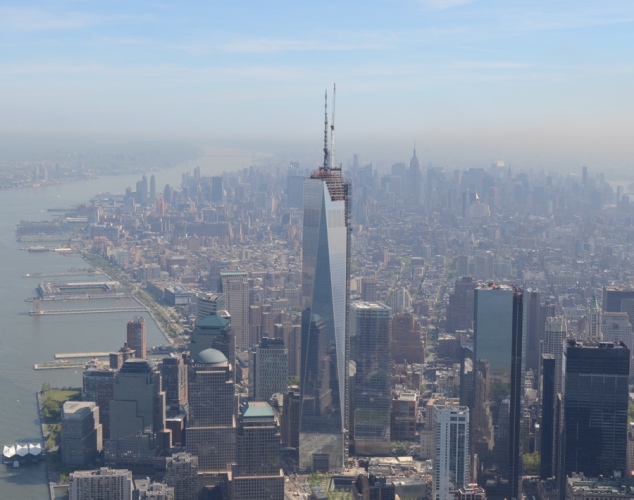
The world’s number one terror target, the 1,776 foot tall Freedom Tower, fell after terrorists carefully laced the interior structure with nanothermite.
NEW YORK — After three consecutive weeks of the most elevated terror alert levels since 2001, synchronized attacks have nonetheless killed millions of innocent Americans on the twelfth anniversary of 9/11, bringing every major city in America to a standstill.
New York City Homeland Security Agents report hundreds of Al-Qaeda agents infiltrated the Freedom Tower construction crew and filled the core of every concrete beam with nanothermite, even as the monumental skyscraper was built. Al-Qaeda sleeper cells successfully evaded all-encompassing NSA surveillance with use of an advanced metaphor cypher which referred to nanothermite as “love” and Allah as “Jesus.” These explosives were detonated this morning, leveling the Freedom Tower before it was completed.
Other Al-Qaeda agents, who made up the majority of the janitorial staff at the Pentagon, hid nanothermite explosives in the office chairs of the highest officials of the US military, killing off the top echelons of the chain of command for the Army, Navy, Coast Guard, and Marines.
Al-Qaeda troops stormed US embassies in Saudi Arabia, Yemen, Oman, the United Arab Emirates, and Jordan, before firing Sarin gas into citizens of Tel Aviv. President Obama has been locked in a smoked-filled room in the back of the White House and is rumored to be discussing whether to use nuclear or biological weapons on Syrian and Soviet targets.
Grieving citizens around the nation, who have changed their 9/11 mantras from “Never Forget” to “Never Again,” are waving American flags and rounding up Muslims at gunpoint, ushering them into the safety of FEMA camps with the help of local and regional law enforcement agencies.
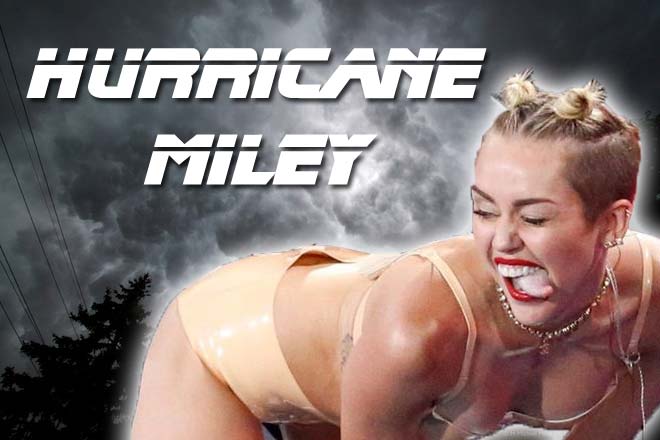
As pseudoevent season approaches, a new naming system for storms draws from pop culture to keep viewers interested in potential disasters. (Actual graphic from The Weather Channel)
With hurricanes building to catastrophic levels off the coast of Africa and the annual 9/11 memorial terror attacks looming, it’s officially pseudoevent season. Analysts expect this year’s rapid-fire Thanksgiving, Halloween, Christmas, and New Year’s holidays to be “bigger than ever and full of surprises.” The terror alert level has been ritually escalated by government officials who also gave a stern warning to citizens, “Do not leave your homes unless it is necessary. Stay tuned to news reports, and stay safe. First Lady Michelle Obama will be holding a press conference this evening and may twerk for cameras after a moment of silence for those brave men and women who died a year ago in Benghazi.”
Dr. Angstrom H. Troubador, media theorist, expects more crossover pseudoevents similar to Richard Reid’s Christmas shoe-bombing. Dr. Troubador told reporters, “I’m expecting bigger pseudoevents than ever this year. We’ll probably see something unimaginable like a Thanksgiving Hurricane or a cyberbullied young girl turned Al-Qaeda suicide bomber. Personally, I’d like to see a child celebrity meltdown turn into a school shooting or Gangnam Style dance trend.”
Meteorologists, hoping to draw more attention to their reporting, are using a new naming system for hurricanes and tropical storms which appropriates names from pop culture. Spokesperson for the Storm Naming Association, Harold Harrison, says, “A recognizable name will make sure the average person has a harder time forgetting about the existence of impending chaos. Tropical Storm Miley is already making big waves both in the Atlantic and on Social Media sites like Twitter!”
Because the public craves increasingly astounding stories, Dr. Troubador tells us the pseudoevent season is becoming longer. “One day all events will be recorded on some sort of media or another and fed directly into a permanent database, shattering the very fabric of reality and ultimately destroying all possibility of freedom. The best we can hope for is an acceptable simulation of what life once was.”
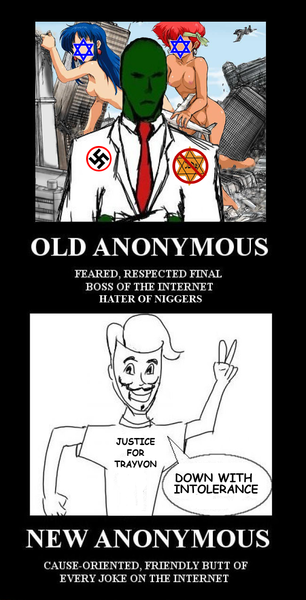
A polemic cartoon contrasts the no-prisoners humor of the “Old Anonymous” with the humorless “New Anonymous.”
Pranks that required hundreds or even thousands of participants found a regular home at the anonymous humor forum 4chan, where the mythical Anonymous wrote the pranks as much as the pranksters wrote the myths. An all-powerful internet entity whose consciousness was constituted by thousands of individuals, Anonymous, resonated with the default anonymous forum, pranks, and powerless young people who made up the majority of the forum.
This mythical Anonymous and “his” many famous pranks formed a strong and mutually determinate relationship with “events” in the news media. Much early reporting on Anonymous pranks relied heavily on a naive (but sensational) reading of the sinister and all-powerful Anonymous mythology, creating a feedback loop which very quickly inspired emphasis of the powerful aspect, “hackers on steroids,” over the humorous. A distinct ideology and aesthetic constructed and were constructed by this feedback loop, and vestigial values of the prankish, leaderless, and mostly unmoderated 4chan forum became deflated and at times inverted as a consequence of hegemonizing processes — power must preserve and expand power to persist. The faceless green jokester splintered into a sea of Guy Fawkes masks and the Anonymous myth re-centered itself on power as power imposed itself upon Anonymous.
Free speech was a naturally shared value in the barely moderated realm of 4chan, but in this new culture where free speech was merely an initiative subsumed by power, such style of speech could not even be practiced internally. Because hierarchy and control of speech could not be implemented on 4chan, those who wished to continue to build power did so on Internet Relay Chat (IRC) channels. On 4chan, free speech was inherent everywhere, but in IRC it was everywhere limited by hierarchical channel moderators who acted to preserve their power. The weak response that anyone could create and control their own channel was the stock answer for complaints about the glaring absence of free speech. Rather than an open playground for speech such as 4chan, IRC servers were a place where anyone could set up controls for speech.
Internally, free speech was valued very differently, but differences were also externally manifest in the oft repeated claim that Anonymous would not (or should not) attack “media.” Media used here apparently meant something like news media, and one was left wondering if Anonymous preferred the “legitimate” and powerful news media over independent journalists. Certainly that wasn’t the case. Various Internet and communication media formed precisely the sphere in which relevant Anonymous operations obtained. Denial of Service (DoS) “attacks,” which were some of the rare instances in which post-prank Anonymous acted collectively and spontaneously, targeted communication systems of a subject of protest. Many supporters shared the common metaphor-as-argument which likened DoS to sit-ins. Unlike in the metaphorical sit-in, targeted systems (segregated restaurants) were necessarily less affected by the flood of packets (“sit-in”) than all the systems which relayed the packets (something more like blocking the streets everywhere near the restaurant).
Many of these historic DoS attacks were “successful” only with the use of botnets, or networks of cracked systems. Here, the myth of Anonymous fell into the tomb world of pure fabrication and in a sense was ultimately disconnected from its origin. There were often not enough participants in DoS “sit-ins” to achieve the goal of shutting down the subjects of protest, but that was no longer a central element to the culture or even a relevant point — power was more important. Those who participated acted merely as convenient cover for those who had botnets, thinking themselves part of a collective identity.
Leaders, figureheads, or celebrities also became pivotal actors despite the ideological insistence against this. Barrett Brown, a freelance writer, acted as an intermediary between Anonymous and the news media. After securing a “six-figure” book deal with perennial Anonymous enemy, Amazon, Brown was raided by the FBI and descended into something like a psychosis which came to a head in a series of YouTube videos in which Brown made threats to an FBI agent and his family. Brown was continually forgiven for his celebrity antics by many Anons who cited his contributions to their (fight against) power, showing more strong evidence that power was the central value, one which eclipsed even the eponymous value, anonymity.
Sabu, a prominent cracker, drew the admiration of tens of thousands of fans and acted as an organizer for “Antisec,” an Anonymous operation which purported to centralize and process information stolen from government systems around the world. However, Sabu was targeted by investigators specifically for his influence, which the FBI then wielded to direct crackers, such as Jeremy Hammond, to target systems which potentially provided the US with useful intelligence. This was an unsurprising climax for a culture which valued power above all else.