Hyperanal sex is a new form of super-sensual intercourse where a prolapsed rectum is inserted into another’s anus.
INTERNET–A new form of anal-on-anal sex has been invented by pioneering porn starlet and writer Sasha Grey. “Basically, I extrude a section of my rectum past my sphincter and insert it into another gaping asshole. It feels so good.”
Already, thousands of enthusiasts of what’s been dubbed “hyperanal” sex have learned to extrude their rectum out of their anus, posting video tips for those who are interested in reaching the “next level” of orgasmic sexual pleasure.
Critics suggest hyperanal sex is not safe, and parents are increasingly concerned as practice of hyperanal spreads into high schools. “Intentional anal prolapse may lead to a permanent condition where the patient has no control of bowel movements. Corrective surgery is dangerous and expensive,” said Dr. Angstrom H. Troubador.
Murderers of Aaron Swartz tried to disguise his death as a suicide.
NEW YORK — After reports of Aaron Swartz’s apparent suicide circulated around the Internet this weekend, investigators found evidence of foul play. A former architect of Reddit, the online forum scandalized earlier this year by child pornography and “creepshots,” Aaron Swartz was widely known for his contributions to anti-copyright activism after stealing millions of files from MIT.
Hackers from Anonymous released a statement on Sunday, “Heavy-handed prosecutors raped the beautiful mind of Aaron Swartz. He later ‘killed himself.’ Are the draconian copyright laws selectively applied to those who threaten the inertia of entrenched power? Certainly. Will they use their sockpuppets and judicial torture system to make YOU kill yourself too? Of course. Will they kill you if you go too far?”
Chronicle Reporters also questioned Julian Assange, sick from months of exile in the Ecuadorean embassy, about the death of Aaron Swartz. “I am not convinced that Aaron Swartz was such a coward he committed suicide due to fear of prison,” said Mr. Assange. “Read his words, and decide for yourself, but I believe Swartz was murdered by a team of copyright assassins who made it all look like a simple suicide. Watch what you say, or you may end up like Aaron Swartz.”
Swartz gave a talk in 2008, mentioning his intention to ” download scientific journals and upload them to file sharing networks.”
Information is power. But like all power, there are those who want to keep it for themselves. The world’s entire scientific and cultural heritage, published over centuries in books and journals, is increasingly being digitized and locked up by a handful of private corporations. Want to read the papers featuring the most famous results of the sciences? You’ll need to send enormous amounts to publishers like Reed Elsevier.
There are those struggling to change this. The Open Access Movement has fought valiantly to ensure that scientists do not sign their copyrights away but instead ensure their work is published on the Internet, under terms that allow anyone to access it. But even under the best scenarios, their work will only apply to things published in the future. Everything up until now will have been lost.
That is too high a price to pay. Forcing academics to pay money to read the work of their colleagues? Scanning entire libraries but only allowing the folks at Google to read them? Providing scientific articles to those at elite universities in the First World, but not to children in the Global South? It’s outrageous and unacceptable.
“I agree,” many say, “but what can we do? The companies hold the copyrights, they make enormous amounts of money by charging for access, and it’s perfectly legal — there’s nothing we can do to stop them.” But there is something we can, something that’s already being done: we can fight back.
Those with access to these resources — students, librarians, scientists — you have been given a privilege. You get to feed at this banquet of knowledge while the rest of the world is locked out. But you need not — indeed, morally, you cannot — keep this privilege for yourselves. You have a duty to share it with the world. And you have: trading passwords with colleagues, filling download requests for friends.
Meanwhile, those who have been locked out are not standing idly by. You have been sneaking through holes and climbing over fences, liberating the information locked up by the publishers and sharing them with your friends.
But all of this action goes on in the dark, hidden underground. It’s called stealing or piracy, as if sharing a wealth of knowledge were the moral equivalent of plundering a ship and murdering its crew. But sharing isn’t immoral — it’s a moral imperative. Only those blinded by greed would refuse to let a friend make a copy.
Large corporations, of course, are blinded by greed. The laws under which they operate require it — their shareholders would revolt at anything less. And the politicians they have bought off back them, passing laws giving them the exclusive power to decide who can make copies.
There is no justice in following unjust laws. It’s time to come into the light and, in the grand tradition of civil disobedience, declare our opposition to this private theft of public culture.
We need to take information, wherever it is stored, make our copies and share them with the world. We need to take stuff that’s out of copyright and add it to the archive. We need to buy secret databases and put them on the Web. We need to download scientific journals and upload them to file sharing networks. We need to fight for Guerilla Open Access.
With enough of us, around the world, we’ll not just send a strong message opposing the privatization of knowledge — we’ll make it a thing of the past. Will you join us?
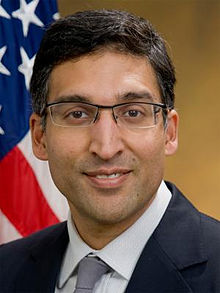
Acting Attorney General Neal Katyal, who this week outlined the administration’s shift from state-based health care exchanges to “chilling out”
WASHINGTON — Friday morning Acting Attorney General Neal Katyal announced that the Obama administration would be backpedaling from its take on the commerce clause to forward the “holy, righteous cause” of recreational cannabis legalization. Bolstered by praise from Colorado and Washington state Democratic leaders, and directives from the highest echelons of the Obama administration, Mr. Katyal announced in a press conference that the results of the landmark case Gonzales vs. Raich were “not cool” and were keeping millions of Americans from “chilling out” and “lighting up, man.”
Reached by phone in his Fairfax office at George Mason University Law School, Professor Michael Greve said the new anti-commandeering stance would prove exciting to Libertarian Party devotees at the Mercatur Institute and millions of drug-addled American liberals, most of whom are dependent on federal largesse for their barest subsistence.
“The Patient Protection and Affordable Care Act,” said Mr. Greve, “established a conditional pre-emption regime in which the federal government told the states, ‘establish an exchange or we will do it for you.'” Following 18 more conservative states having in essence told the government to come in and establish exchanges, Mr. Greve said, “these states have told the federal government to take responsibility for the inevitable failure of these health care regimes.”
Mr. Katyal said in a press conference Friday morning, “As long as Congress refuses to act to deschedule cannabis from the same tier as heroin — come on, heroin, people — the administration must act.” The administration’s tight, 180-degree turn came on the heel of several online townterviews, during which poll respondents consistently begged the administration to cease the notoriously racist drug war. In his weekly address today, a visibly intoxicated President Barack Obama spoke to his office webcam in a cloud of smoke, admitting, “Millions of toothless Southern and Midwestern Americans, who will never vote for me, anyway, versus a good time for the peace-loving denizens of Colorado and Washington state? That’s an easy choice for me, bra.”
Following an on-screen hit from a gravity bong haphazardly constructed from a Chicago Bears novelty cup, which the 51-year-old U.S. president described as “vicious,” he said, “I realize the insane hypocrisy of my having smoked marijuana for recreation before overseeing a federal regime that incarcerates millions of Americans — particularly African-Americans — in such record numbers. Something had to be done, and I have directed the Department of Justice to just scrap this health care reform thing.”
Attorney General Eric Holder released a statement saying he now concedes that “all of these Republican attorneys general, they’re right, man. Just as we can’t force these conservative states to establish exchanges, we also can’t use the commerce clause to force this horrible drug war down the throats of Colorado and Washington citizens. The voters have spoken. Let freedom reign.”
House Whip Steny Hoyer (D-MD), speaking to Politico, said that the legislative slowdown that faced descheduling cannabis was fueled by an ambiguity around the level of taxation that the illicit industrial psychoactive crop should receive. “If we had chosen to tax it too high, we would fuel black market activity. If we had voted to tax it too low, we just wouldn’t be taking our deficit seriously, and that would be unpatriotic.”
Internet Chronicle legal analysts have long predicted that the landmark Gonzales case would prove problematic for the Obama administration’s main objective — even if that objective were only background or covert — of legalizing the sticky-icky. In the wake of this decision, Iran and Russia are expected to overtake within weeks the United States in terms of arbitrary and/or politically motivated incarceration.